
How I Do My Etsy Shop Bookkeeping in 15 Minutes a Month
If the money side of your Etsy shop makes your stomach drop, you are in very good company. I ran mine for years while quietly dreading anything to do with numbers, fees, or taxes. So this isn't a pep talk — it's the actual, boring-in-a-good-way system I use now. It takes about fifteen minutes a month, and it turned tax season from a panic into a non-event. Here's exactly how it works.
First: know what Etsy actually takes
Most new sellers are shocked by how much comes out of each sale, because it's taken in several different places. As of 2026, here's what leaves a typical order:
- Listing fee: $0.20 per item — charged when you list, and again each time one sells.
- Transaction fee: 6.5% of the total — and that includes the shipping you charge.
- Payment processing: about 3% + $0.25 per order (US).
- Offsite Ads: 15% if your shop is under $10k/year (you can opt out), or 12% if you're over $10k/year (required) — but only when a sale comes from an ad Etsy placed for you.
Quick math on a $50 order: a regular sale runs about $5.20 in fees (roughly 10%). If it came through Offsite Ads, add around $7.50 — so about $12.70, or 25%, gone. Knowing this is how you price so you actually keep money.
Fees change — always confirm the latest on Etsy's Fees & Payments policy page.
The four numbers I track each month
You don't need fancy software. Each month I write down just four numbers, all from my shop's payout summary:
- Net income — what Etsy actually deposited.
- Fees — my total Etsy fees for the month.
- Shipping — what I paid for postage and labels.
- Marketing — Etsy Ads, Offsite Ads, and any promo costs.
Those four tell me my real profit: income minus the other three. That's it.
My 15-minute monthly routine
- Open last month's payout summary from my shop dashboard.
- Write down the four numbers above.
- Add up my business mileage for the month (post office and supply runs count).
- Move about 30% of my profit into a separate "taxes" savings account.
- Close the laptop. I'm done for the month.
The deductions most sellers forget
Every one of these lowers what you owe at tax time. Keep a receipt or a quick note for each — the small stuff adds up fast:
- All your Etsy fees (yes, every one)
- Shipping & postage
- Packaging supplies — mailers, tape, tissue, labels, printer ink
- Materials & supplies — paper, vinyl, tools
- Mileage — post office and supply runs
- Home office — a space used regularly and only for your shop
- Software & subscriptions — design tools, apps, planners
- The business share of your phone & internet
Taxes, without the panic
This is the part everyone avoids, so let's make it simple:
- Set aside about 30% of profit as you go — a separate savings account is the easiest way.
- Quarterly estimated taxes: if you'll owe more than about $1,000 for the year, the IRS expects payments four times a year. Your accountant can set the amounts.
- The 1099-K: for 2026 the threshold is back to over $20,000 and over 200 sales. But here's the key part — you owe tax on your profit whether or not you get the form. Earning is the trigger, not the paperwork.
This is general education, not tax advice. Rates and thresholds change and vary by state — confirm current figures at irs.gov and check with a tax professional about your specific situation.
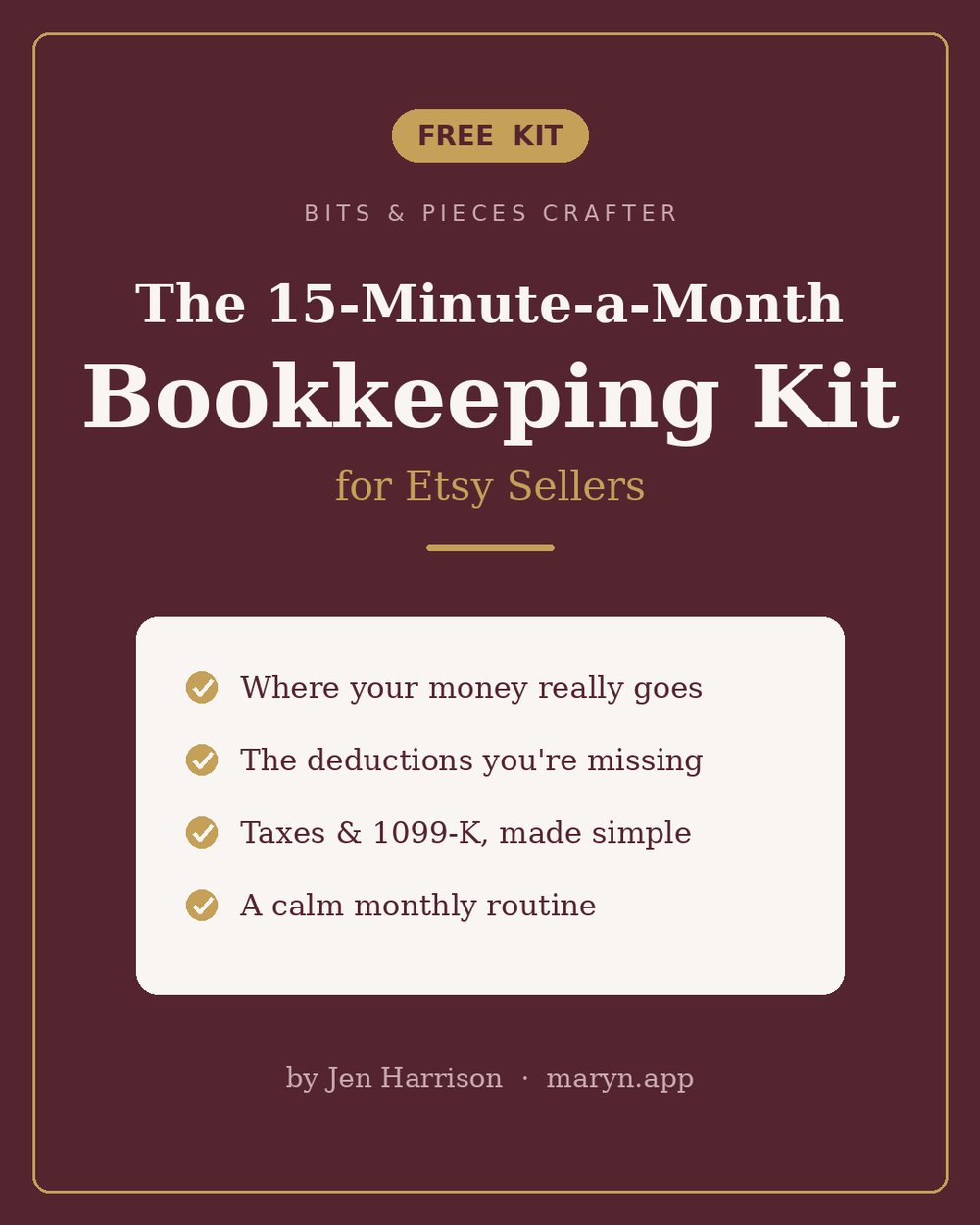
Want this done for you? I put all of it — the full fee breakdown, the deductions checklist, the mileage details, and a print-and-fill yearly tracker — into a free kit you can grab in one click.
→ Get the free 15-Minute-a-Month Bookkeeping Kit
The one habit that makes it stick
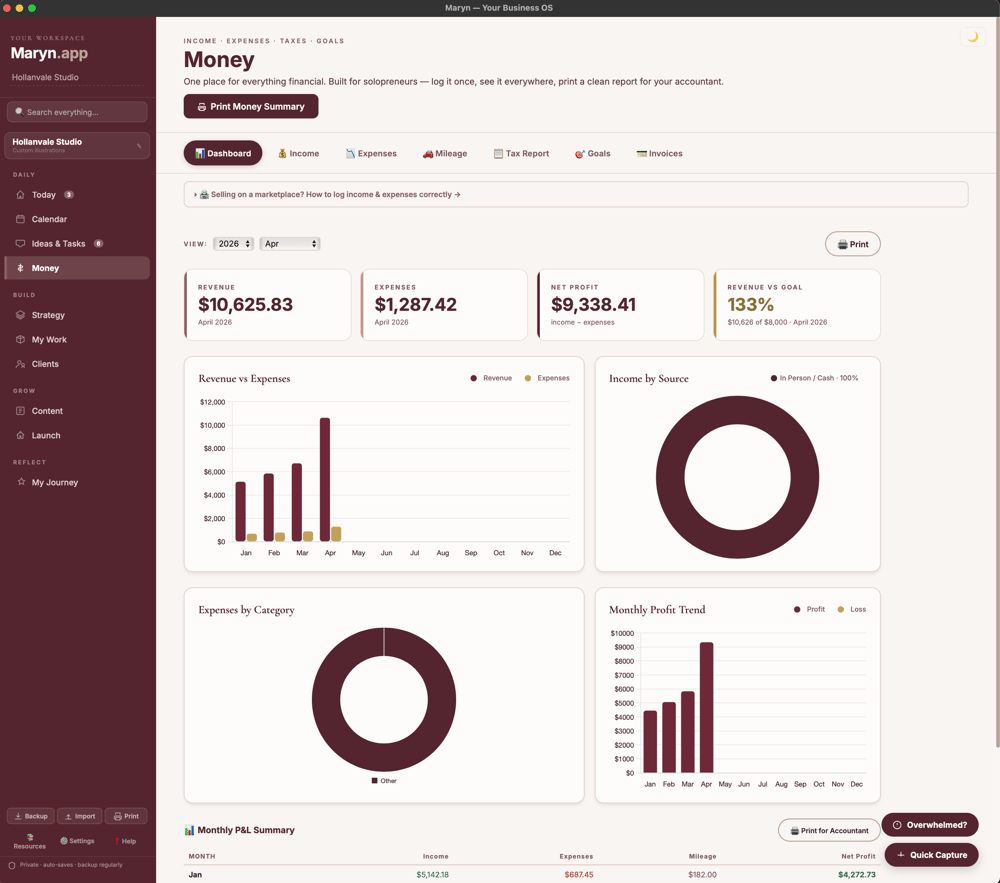
Most sellers fall behind because the numbers live in ten places — the bank, the dashboard, a note here, a receipt there. That's exactly why I built Maryn: a calm app on your own computer that holds your income, expenses, mileage, and a tax-ready report in one place. It's the tool I use to do this whole routine in fifteen minutes — but even a single spreadsheet beats scattered notes. Pick one home for your numbers, and future-you at tax time will be so grateful.
Written by Jen — Bits and Pieces Crafter, LLC.