
Social Media Tip
Why 'be everywhere' is bad advice for a solo maker, a 3-filter method for choosing your platform, what 'going deep' actually requires, and a repurposing system that gives you presence everywhere from one piece of work.
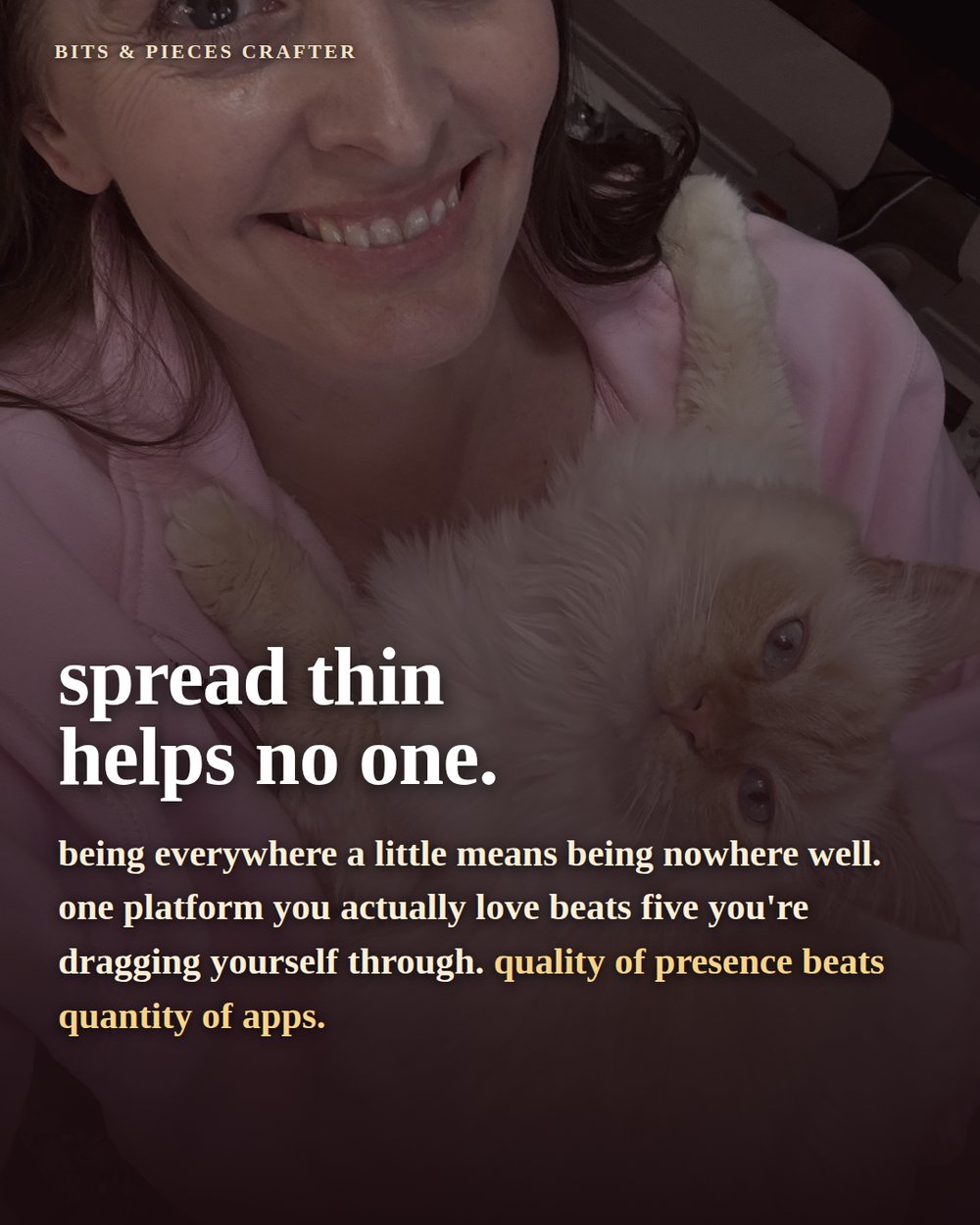
Instagram, TikTok, Pinterest, YouTube, a newsletter, a blog, Threads, Facebook, a shop-update cadence. When I started, I tried to be on all of it, because every guide said I 'had to be everywhere.' What being everywhere actually got me was doing everything badly and being too exhausted to keep any of it up. Spread six ways, I couldn't go deep enough anywhere to matter. I BURNED OUT!
This blog post is the fix: a way to choose where to focus, what focusing actually looks like, and how to still have a light presence on other platforms without burning out. Let's take apart the bad advice first.
Why 'be everywhere' fails a solo maker
Big brands can be on every platform because they have a person or an agency per channel.
You are one human who also designs, makes, photographs, lists, packs, ships, and answers messages. When one person runs six platforms, each gets a sliver of the attention it needs to work — and every platform rewards depth, not scraps.
Here's the counterintuitive part that's easy to miss: shallow presence on six platforms performs worse than committed presence on one. Algorithms reward consistency because they need to learn that you show up, that people engage, that you're worth surfacing to strangers. Five accounts you post to once a month teach the algorithm one thing — that you're unreliable. One account you show up to steadily teaches it to trust you and push you further. Spreading thin isn't hedging your bets; it's quietly guaranteeing none of them land.
The 3-Filter Method for choosing your platform
Don't pick based on where you're 'supposed' to be. Run your options through three filters, and choose where they overlap:
1. Where are your people already? Planner and sticker lovers cluster on TikTok and Instagram; searchable, evergreen, beautifully-shot work thrives on Pinterest. Go where your buyers already scroll, not where you wish they were.
2. What will you actually sustain? This is the filter people skip and the one that decides everything, because you'll have to do this on the uninspired days too. If you dread being on camera, a video-first platform will quietly kill your motivation no matter how 'optimal' it is. A format you enjoy and will keep doing beats a better format you'll abandon.
3. What suits your product? 'Satisfying' process content — peeling stickers, cutting, packing — is tailor-made for short video. Gorgeous flat-lays with a long shelf life are Pinterest's native language. Match the platform to what your work naturally produces, so making content feels like an extension of making product.
Where those three overlap — your buyers, a format you'll sustain, a fit for your product — is your primary platform. Pick it. Maybe add one secondary. Then consciously let the rest go for now. 'For now' matters: this is a focus decision, not a forever vow.
One thing to note, now that I have more systems in place I am able to batch and be present on more social media sites. The big thing is when you are starting you need to start slow to develop your process and your cadence.
What 'going deep' actually requires
Going deep is not just posting more; it's treating one platform as a craft to learn. Concretely, that means:
1. Study what performs and why — save the posts in your niche that pop, and look for the pattern in hooks, formats, and topics.
2. Learn that platform's specific mechanics — how its search works, what its feed rewards, what length and style it favors right now.
3. Engage like a member, not a billboard — reply to comments, join conversations, support other creators, so the platform reads you as an active participant.
4. Give it a real runway — ninety days of consistent effort before you judge it. Most people quit at three weeks and call it 'not working,' when they simply never gave it enough to catch.
Depth compounds. The more you show up in one place, the more the algorithm trusts you, the more the community recognizes you, the more each post builds on the last. That compounding never gets a chance to start when you're scattering single posts across six platforms and resetting to zero on each.
TRY THIS TODAY
Pick your one primary platform using the 3 filters. Then open the five (or six) accounts you're half-running and give yourself permission to let all but one or two go quiet for the next 90 days. Write the date 90 days out somewhere you'll see it — that's when you're allowed to evaluate, and not before.
The repurposing system: presence everywhere from one piece of work
Here's how you keep a light footprint elsewhere without the burnout: create for your primary platform, then repurpose the same asset outward. One vertical video made for TikTok becomes an Instagram Reel, a YouTube Short, and a Pinterest video pin — four places, one piece of work, minutes of extra effort. You're not managing four platforms; you're managing one and letting it echo.
The mistake is trying to create original content for all of them. The move is to create for one and recycle to the rest. A simple rhythm: make it for your primary platform first, natively; then, once a week, spend a short block reposting that week's best pieces to your secondary channels with light tweaks. Presence everywhere, effort in one place.
KEY TAKEAWAYS
• 'Be everywhere' is built for teams; as one person it just spreads you too thin to work.
• Shallow-on-six loses to committed-on-one, because algorithms and audiences reward consistency.
• Choose with 3 filters: where your buyers are, what you'll actually sustain, what suits your product.
• Going deep = study the platform, engage like a member, and give it a 90-day runway before judging.
• Create for one platform, then repurpose the same asset to the rest — presence everywhere, effort in one place.
Whatever platform you commit to, consistency is the whole game — come see what showing up steadily looks like over at Bits & Pieces Crafter, Mayn.app and my etsy shop!