
The single most common mistake handmade sellers make with pricing, a plain-language formula that actually pays you, and how to hold that price with confidence when someone points at the cost of your materials.

'But the supplies only cost two dollars.' If you sell anything handmade, you've heard some version of this — maybe from a customer, maybe from the voice in your own head. It's the sentence that keeps thousands of talented makers underpaid, because it quietly assumes the only thing worth paying for is the raw material. It leaves out the most valuable ingredient in everything you sell: you. This post is about putting yourself back into the price.
I priced for supplies for far too long, and I have the burnout to prove it. Let me walk you through why that math fails, a simple formula that actually accounts for your time, and how to sit calmly with a fair price even when someone raises an eyebrow.
Why 'materials plus a little' quietly guarantees burnout
When you price at materials plus a small bump, you've accidentally decided that your hours are free. But those hours are the whole business.
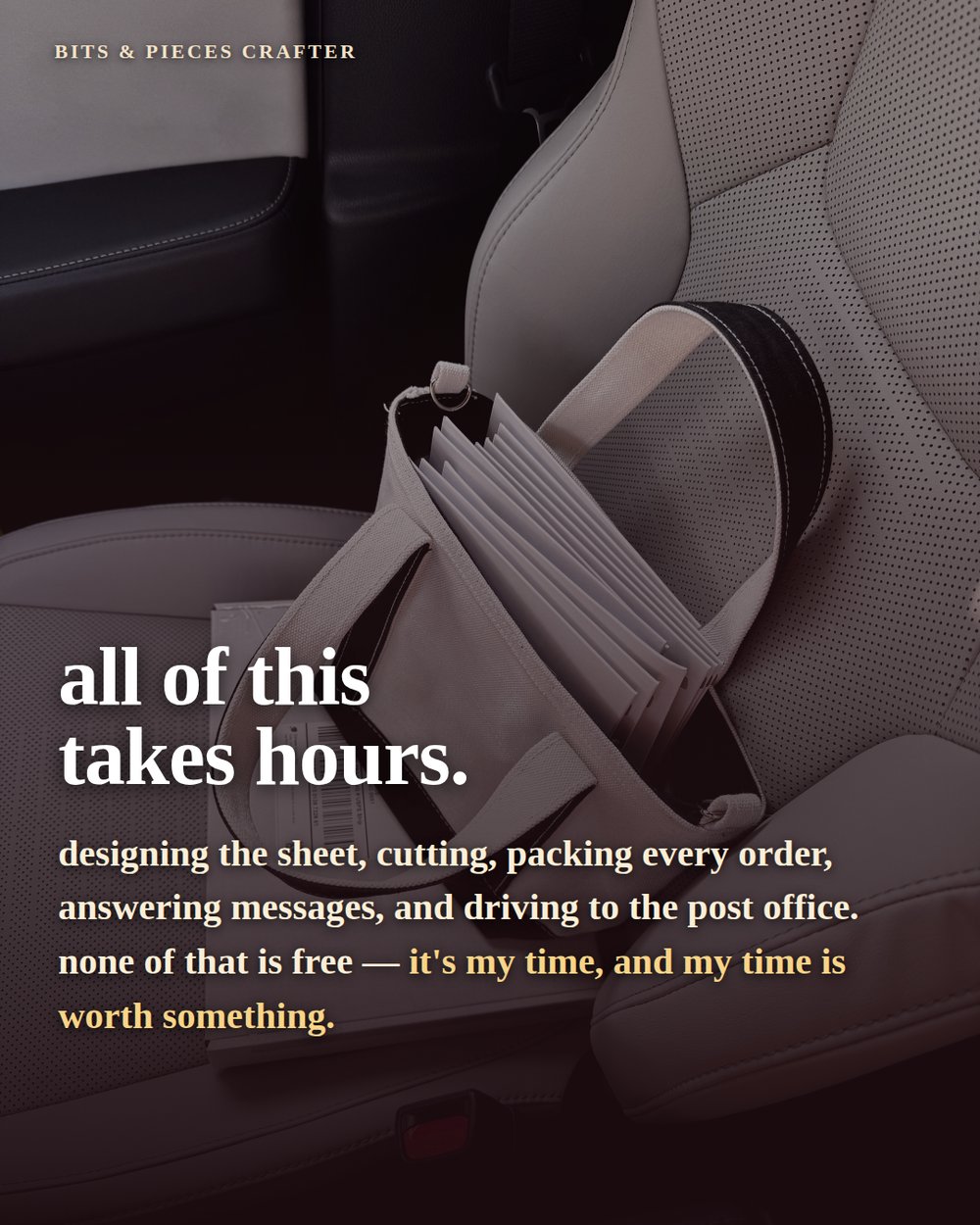
The design time, the trial and error, the photography, the listing, the messages, the packing, the trip to the post office — none of it is free to you, so none of it should be free to the customer.
If your price only covers supplies, every single sale actually costs you money in unpaid labor. That's not a business; it's a subsidy you're paying your customers to buy from you, and it's why so many makers quietly quit exhausted and broke.
The plain-language pricing formula
You don't need a finance degree. Here's the whole thing, and it works for stickers, prints, knits, candles, anything:
1. Materials — the real cost of everything that goes into one finished item: paper, ink, packaging, the sticker backing, a share of that test print you threw away. Add it up honestly.
2. Labor — your time, paid at a real hourly rate you choose, for every stage: designing, making, photographing, listing, packing. Pick an hourly number you'd actually accept, then multiply by the honest time per item.
3. Overhead — a small slice of the costs that keep the whole shop running: software, fees, your machines, marketplace commissions. Spread across your items, it's often a modest per-item amount, but it's real and it belongs in the price.
4. Profit margin — an amount on top, above covering costs, so the business can grow, restock, and survive a slow month. Covering your costs is breaking even; the margin is what makes it a business instead of a very tiring hobby.
Add those four together and you have a price that pays you. It will almost certainly feel too high at first — that feeling is years of underpricing talking, not evidence that the number is wrong. Sit with it before you flinch and cut it.
TRY THIS TODAY
Pick your single best-selling item and run all four steps on it honestly — especially the labor line, timed for real. Compare that number to what you currently charge. You don't have to change your price this minute; just look clearly at the gap. Most makers are quietly stunned, and that clarity is the first step to fixing it.
The wholesale gut-check
One more test that reveals underpricing instantly: could you sell this at wholesale — roughly half your retail price — and still not lose money? Real products need to work at both retail and wholesale, because that's how growth happens. If cutting your price in half would mean losing money on every sale, your retail price is too low, full stop. This one question has re-priced more shops than any spreadsheet.
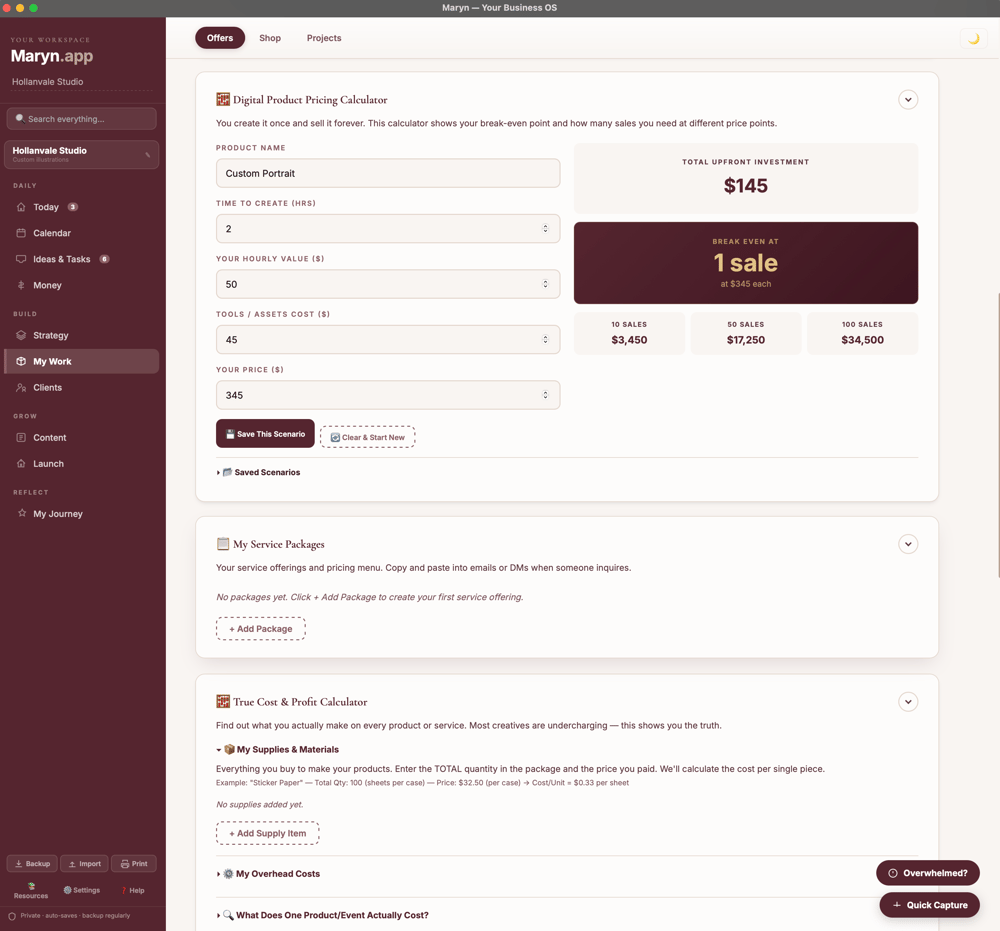
Our Maryn application helps you determine your true costs and what your time is worth.
Check out the My Work Section of Maryn.app
Holding the price when someone pushes back
When someone says 'the supplies only cost two dollars,' you don't need a defensive paragraph. You're not charging for two dollars of vinyl; you're charging for the years it took to make something worth buying, and the hour it took to make this one.
Most people who truly value handmade work already understand that. The ones fixated on material cost alone were never going to be your best customers anyway. Price for the maker, not just the materials — and let the right people happily pay it.
KEY TAKEAWAYS
• Pricing at materials-plus-a-little decides your time is worth nothing — and quietly guarantees burnout.
• Real price = Materials + Labor (at a real hourly rate) + Overhead + Profit margin.
• A fair price feeling 'too high' is usually underpricing history talking, not a real signal.
• Gut-check: if you couldn't sell it at half price without losing money, your retail is too low.
• You're charging for the maker and the hours, not the vinyl — the right customers already know that.
Knowing your numbers is half the battle — seeing them in one place is the other half. That's exactly what I built maryn.app to do; here's a walkthrough: Maryn.app Walkthrough